What Is BPA-Free and Why It Matters for Insulated Drinkware
A practical guide to BPA-free insulated drinkware, including health concerns, major market rules, and the best materials for tumblers, lids, and bottles.
3/10/20264 min read
If you source insulated tumblers, water bottles, or stainless steel drinkware for the North American or European market, you have probably seen one term come up again and again: BPA-free.
1 What Is BPA?
BPA stands for Bisphenol A, a chemical that has been widely used for decades, mainly in polycarbonate plastics and epoxy resins. According to the U.S. National Institute of Environmental Health Sciences, BPA is used in products such as polycarbonate plastics and epoxy resin linings, and it can migrate into food or beverages from some food-contact materials.
Reference: National Institute of Environmental Health Sciences-BPA
That matters because older drinkware and food-contact products sometimes used BPA-containing materials where clarity, strength, and impact resistance were important. In practical terms, BPA became closely associated with certain rigid clear plastics, especially older polycarbonate drinkware components.
2 Why Are People Concerned About BPA?
BPA has attracted so much attention because it is widely discussed as an endocrine-disrupting chemical, meaning it may interfere with the body’s hormone system. Researchers and regulators have been especially concerned about long-term, repeated exposure, rather than short-term toxicity.
The health discussion around BPA usually focuses on areas such as reproductive health, early-life development, metabolism, and the immune system. The European Food Safety Authority (EFSA), in its 2023 re-evaluation, concluded that dietary exposure to BPA is a health concern and significantly lowered its tolerable daily intake.
Reference: European Food Safety Authority-Risk related to BPA
At the same time, it is important to stay accurate and balanced. The U.S. FDA’s current position is different: it states that BPA is safe at the current levels occurring in foods for its currently approved uses. That difference is exactly why BPA remains such an important topic in food-contact drinkware development. It is not just a marketing phrase. It sits at the intersection of science, regulation, and customer expectation.
Reference: U.S. Food & Drug Administration-BPA Use in Food Contact Application
3 BPA-Free Rules in Major Markets
For buyers sourcing insulated tumblers, stainless steel bottles, and reusable drinkware, the key point is simple: the EU is currently the strictest major market, while the U.S., Canada, and Australia/New Zealand are more nuanced.
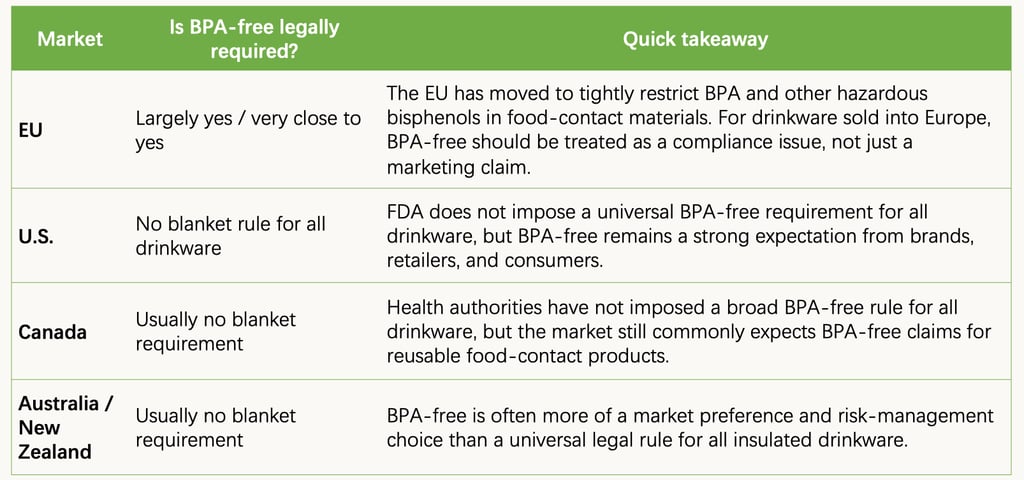
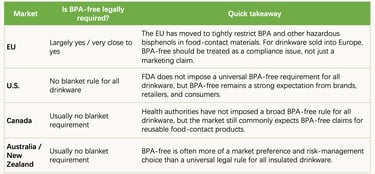
In short, if you are sourcing insulated drinkware for multiple markets, designing for BPA-free compliance is usually the safer and more commercially practical path.
4 Common BPA-Free Materials in Drinkware
In modern drinkware manufacturing, most suppliers have already moved away from BPA-containing plastics. Today, the most common BPA-free materials in insulated tumblers and bottles are PP, Tritan, silicone, and stainless steel, depending on the part and its function.
PP (Polypropylene) is widely used for tumbler lids, straw parts, and other food-contact components. It is popular because it offers good heat resistance, chemical stability, and cost efficiency. The downside is that PP is usually not fully transparent.
Tritan copolyester is often used when brands want a clear, durable plastic part. It is commonly found in clear lids, bottle bodies, and viewing windows, especially in more premium drinkware products.
Silicone is typically used for seals, gaskets, and flexible drinking components. Since BPA is mainly associated with polycarbonate plastics and epoxy resins, food-grade silicone is generally considered BPA-free. Still, buyers should also check whether the material is suitable for food contact and supported by proper compliance documentation.
Stainless steel, such as 304 or 316, is commonly used for the body of insulated drinkware and does not involve BPA. However, BPA-free still matters for the complete product, because most stainless steel tumblers also include plastic or silicone lids, straws, sliders, and seals.
5 Why BPA-Free Is Also a Supply Chain Issue
For buyers, BPA-free is not only about choosing the right resin. It is also about making sure the claim is consistent across production.
For a reliable drinkware factory or tumbler manufacturer, that usually means:
verified raw material sourcing
supplier declarations
technical documents such as TDS and SDS
food-contact compliance records
stable production control and traceability
This is where many sourcing projects go wrong. A factory may say a tumbler lid is BPA-free, but if it cannot provide supporting material information or relevant compliance paperwork, that claim becomes much harder to defend with retailers, importers, or regulatory reviewers.
In practice, experienced suppliers are often able to provide documents such as material declarations, migration test reports, and food-contact compliance statements aligned with destination-market requirements. However, raw material documentation alone is not always enough. It can show what was intended at the material level, but it cannot fully guarantee that no unwanted substances were introduced during compounding, coloring, molding, assembly, or other production steps.
That is why third-party testing of both components and finished products is also important, especially for new products, new molds, or new suppliers. Independent testing helps verify that the final product still meets BPA-free and food-contact requirements after the full manufacturing process, rather than relying only on upstream material claims.
6 A Practical Buying Perspective
In today’s market, especially in North America and Europe, most buyers no longer see BPA-free as a premium feature. They see it as a basic expectation for reusable drinkware, insulated tumblers, and food-contact lid components.
So when you evaluate a supplier, the real questions are usually:
Are the materials actually appropriate for the product design?
Can the factory explain why PP, Tritan, silicone, or stainless steel was selected?
Can the supplier support the claim with documentation?
Does the product meet the compliance needs of the target market?
For B2B buyers, this is where an experienced insulated tumbler manufacturer adds value. The right supplier should not only produce the product. They should also understand how material choice, food-contact compliance, cost, durability, and appearance fit together in real product development.
Final Thoughts
BPA-free sounds like a simple label, but in reality it reflects a much bigger picture: material science, regulatory expectations, supply chain control, and customer trust.
For brands, importers, and product developers sourcing insulated tumblers, stainless steel bottles, and custom drinkware, understanding what BPA-free really means can help avoid costly mistakes. It can also make product development smoother, especially when multiple markets and compliance expectations are involved.
Make Contact Now
Request a quote, or discuss your custom drinkware project
Engineered for Those Who Expect More
Your trusted OEM/ODM manufacturer of insulated containers.
CONTACT US
subscribe for THE latest catalog
Email: hello@yunuocup.com
© 2019-2026 YUNUO DRINKWARE. ALL RIGHTS RESERVED.
Address: No. 6, Jiangwan Rd., Wuyi County, Zhejiang 321200, China
RESOURCES